Emergency Leak Detection in Wilmington, NC
A leak you can't see is still a leak you're paying for. We find it fast, without guessing and without digging up the whole yard to do it.
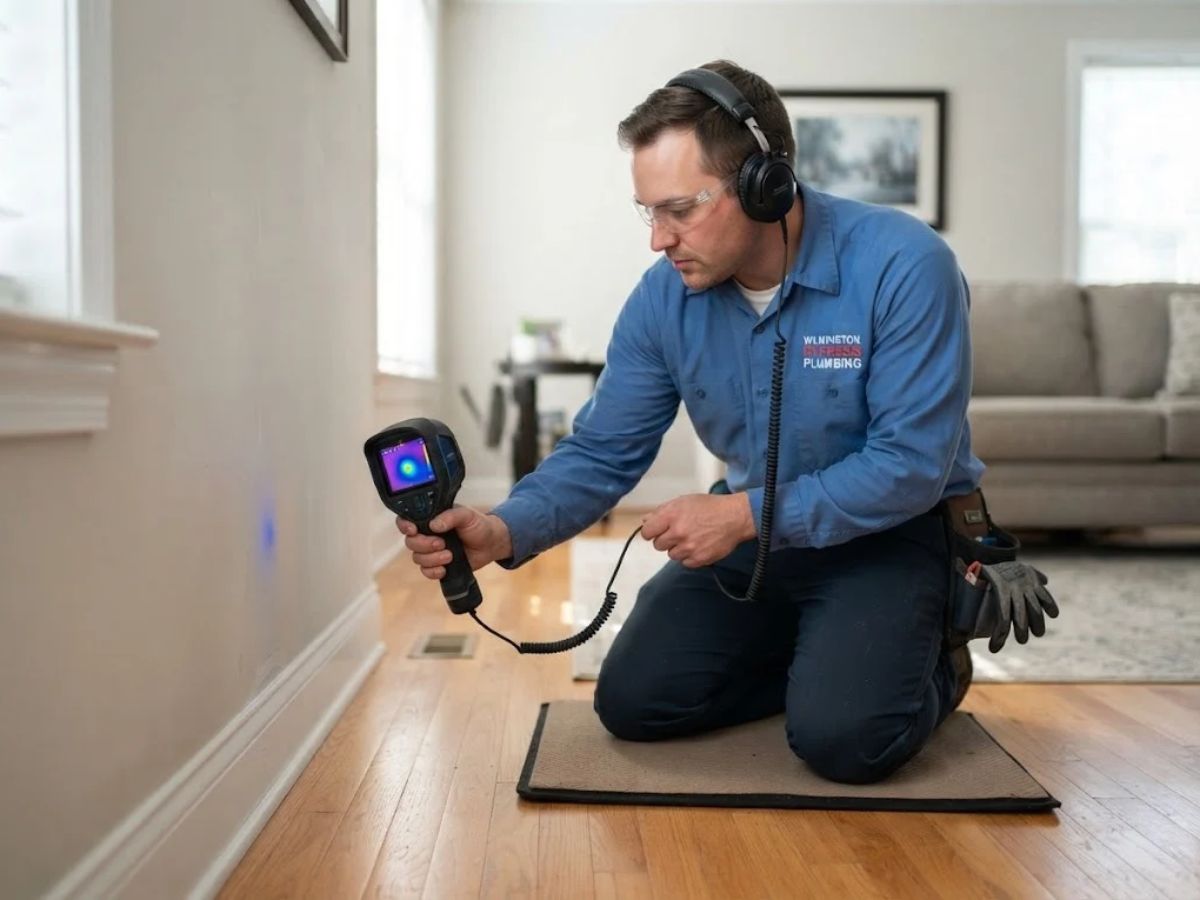
If your water bill jumped for no reason, or there's a warm patch on the floor near the water heater closet, something is leaking somewhere you can't see it. Leak detection in Wilmington, NC means finding that exact spot before it turns into a bigger repair, whether the leak is under a slab, inside a wall, or running along a buried service line.
Homeowners usually call us for one of two reasons: a bill that's climbing with no obvious cause, or a physical sign like a soft floor, a musty smell, or a hissing sound near a wall. Both are worth a same-day look, because a slow leak under a slab foundation, common in New Hanover County's newer subdivisions, rarely stays slow for long. If the leak is coming directly from the tank itself rather than a supply line, that's usually a water heater repair call instead, and we'll point you the right direction on the phone.
Why hidden leaks are common in Wilmington homes
Wilmington sits on sandy coastal soil with pockets of Piedmont clay. That soil expands and contracts with seasonal rainfall, and the movement puts real stress on pipe joints running beneath slab and crawl-space foundations. A joint that was solid when the house was built can work loose over ten or fifteen years of that shifting. The first sign is usually a leak, not a visible crack.
The area's humid subtropical climate adds a second factor: constant moisture and salt-laden coastal air accelerate corrosion on older galvanized and copper supply lines faster than in a drier inland climate. That's part of why PEX has become the more common repair material here, since it resists the corrosion pattern that eventually pinholes an aging copper line.
Signs you have a hidden leak
- Water bill increased noticeably with no change in household water use.
- A warm spot on the floor, especially near a water heater closet or garage slab edge.
- The water meter dial keeps moving even with every fixture in the house shut off.
- A damp or musty smell in one room with no visible source.
- A hissing or trickling sound inside a wall or under the floor.
- Unexplained mold or a soft, spongy patch on drywall near a plumbing wall.
If you're not sure it's a "leak detection" problem
Most people who call us don't use the phrase "leak detection" at all. They say the meter is still running with the water off, or the water bill went up and they don't know why, or there's a warm spot on the floor near the garage. All three of those are exactly what leak detection equipment is built to solve.
The short version: if you can't see where water is coming from but you're confident it's going somewhere, that's a detection job, not a guess-and-cut repair. If instead the water is backing up rather than disappearing, that's more likely a drain cleaning issue than a leak. We locate the leak first, then talk through the actual fix.
How we actually find the leak
We start by isolating whether the leak is on the supply side or the drain side. The water meter is the first test: if the dial moves with every fixture off, the leak is in the supply line somewhere between the meter and the house, or inside the home's plumbing itself.
From there we use acoustic listening equipment to trace pipe sound along the suspected run, and thermal imaging to spot a temperature difference in flooring or drywall that a hot-water leak often creates. For a suspected slab leak, this combination usually narrows the location to a small, specific area rather than a general room.
Only once the leak is pinpointed do we talk about access. In most cases that means a small, targeted opening rather than tearing out an entire slab section or wall, which keeps both the disruption and the repair cost down.
Want us to take a look? Call (919) 944-7281 and we'll walk through what you're seeing.
Repair approaches once the leak is found
| Approach | Best for | Trade-off. |
|---|---|---|
| Spot repair | A single pinhole leak or cracked joint in an otherwise sound line | Fast and cheaper, but doesn't address a line that's corroding in multiple spots. |
| Re-route around the slab | A slab leak where cutting concrete should be avoided | Avoids demolition, adds some pipe length and fittings. |
| Full repipe (PEX) | Older galvanized or copper lines with repeated leaks | Higher upfront cost, but ends the pattern of recurring leak calls. |
What affects the price
- Whether the leak is on the supply side or the drain side.
- Depth and accessibility: under a slab, in a crawl space, or inside a finished wall.
- How much of the existing line shows corrosion beyond the single leak point.
- Repair method chosen: spot repair, re-route, or full repipe.
- Any drywall, flooring, or landscaping that needs to be opened and restored.
Non-emergency estimates are free. For emergency work, we give you the real number before we start. Want yours? Call (919) 944-7281.
Real limits, stated honestly
We don't offer a flat guaranteed price over the phone for a leak we haven't located yet. The repair cost genuinely depends on where the leak turns out to be and how much of the surrounding line is affected. What we do offer is a firm, upfront number once the leak is found and before any repair work starts.
Homeowner's insurance in North Carolina typically covers sudden, accidental water damage from a burst pipe but not the slow, ongoing leak itself or general wear-and-tear corrosion, so document the damage with photos and check your specific policy before assuming coverage.
If a home has had more than one leak in different spots over the past year or two, the underlying pipe material itself may be the real problem, not each leak individually. In that case, whole-home repiping is usually the more honest recommendation than another round of spot repairs.
Questions before you decide? Call (919) 944-7281, 24/7.
Leak detection questions from Wilmington homeowners
Not to find it. Acoustic and thermal equipment let us narrow the location without opening anything. A small access point is usually only needed for the repair itself, not the search.
Yes, and it's one of the most common reasons we get called. A slab or underground leak can run for weeks with no visible sign except a rising bill.
The initial diagnostic visit and locating the leak is priced upfront before we start. Once we know exactly where it is, you get a firm repair quote before any work begins.
Yes. Plumbing contractors in North Carolina are licensed through the State Board of Examiners of Plumbing, Heating and Fire Sprinkler Contractors.
We cover Wilmington and the surrounding New Hanover County area. Call (919) 944-7281 to confirm coverage for your specific address.
Water bill climbing and you don't know why?
Call (919) 944-7281. We'll walk you through it.